
Updated:
The Numbers Don’t Lie. Your Contractor Does.
Finding the best fitout company in Dubai isn’t about the lowest number on a spreadsheet; it’s about identifying the financial black holes they deliberately omit. A 30% budget overrun is considered normal in this market for any commercial & office fitout. I’ve seen 50%. The quote you are holding is not a promise. It’s a weapon of financial attrition. Its primary function is to secure your signature, after which the real costs begin to bleed out through a series of variation orders, exclusions, and calculated omissions. This isn’t a guide. It’s a checklist of doom. Use it to dissect your quote before it dissects your budget.
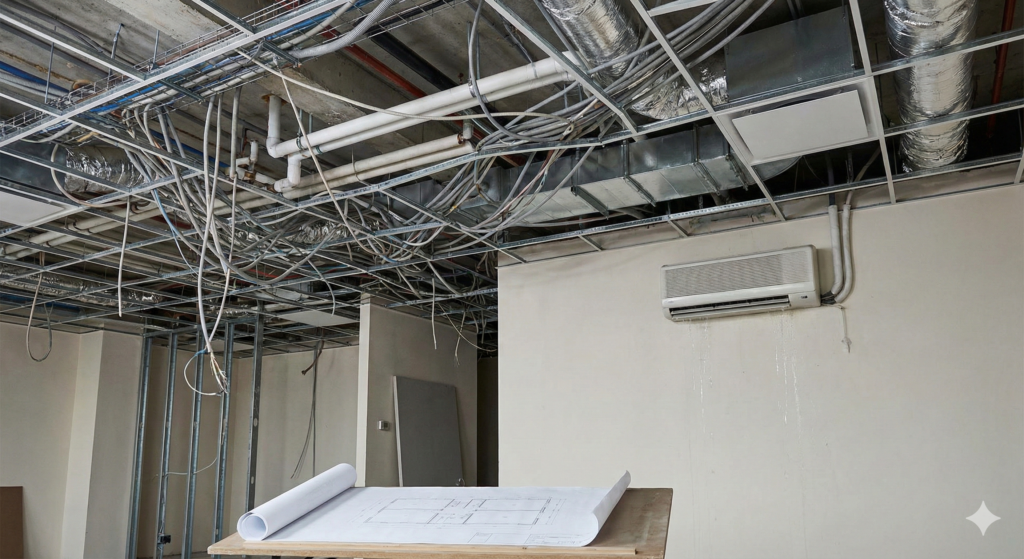
1. The “Authority Approvals” Shell Game
Red Flag: A single, vague line item labeled ‘Provisional Sum for Authority Approvals’ or ‘Statutory Fees’. It’s usually a suspiciously round number, like AED 25,000.
Hard Question: Provide a granular, line-item breakdown of all anticipated fees for Dubai Municipality (DM), DEWA, and Dubai Civil Defence (DCD). This must include submission fees, inspection appointment costs, NOC fees, and final certification costs. What is your financial and time contingency for resubmission if the initial DCD fire safety plans are rejected? What’s your track record on first-pass approvals?
Deep Dive: Here’s where it gets ugly. The contractor inserts a placeholder number that, at best, covers the initial submission. They won’t tell you that the approval process is a complex and multifaceted beast. The Dubai Municipality permit for structural alterations is entirely separate from the DCD approval for fire and life safety systems, which is again separate from the DEWA requirements for your new electrical load. A DCD inspector demanding an extra fire door or a change in sprinkler head density will trigger a mandatory architectural revision, which then requires resubmission to DM. Each step has a fee. Each resubmission has a fee. The contractor’s lowball provisional sum is exhausted after the first meeting, and then the variation orders start. I’ve seen ‘provisional sums’ of AED 30,000 balloon into AED 150,000 in actual costs, excluding the weeks of project delays while paperwork is shuffled between departments. The contractor knows this. They are betting on your ignorance of the process.

2. MEP: The Million-Dirham Miscalculation
Red Flag: Boilerplate language like ‘MEP works as per site requirements,’ ‘Standard HVAC system to be provided,’ or ‘Electrical works to suit office layout.’ This is financial negligence disguised as a quote.
Hard Question: Provide the complete MEP design specifications before I sign anything. I need the calculated cooling load in BTUs, the exact make, model, and country of origin for all HVAC units, the electrical load calculations mapped to our specific equipment list, and the proposed single-line diagram. Is this design coordinated using BIM or are we hoping for the best with 2D AutoCAD drawings?
Deep Dive: The contractor won’t tell you that ‘standard’ is code for ‘the cheapest legally permissible option’. That ‘standard’ HVAC unit might be a no-name brand with poor energy efficiency, which means your DEWA bills will be an operational nightmare for the next five years. The quote doesn’t account for the actual heat load from your server room, your 50 workstations, and the west-facing glass facade. When the AC can’t keep up in July, fixing it means tearing out the ceiling. It’s a catastrophic failure point. The absence of BIM (Building Information Modeling) is another tell. Competitors like Summertown Interiors and A&T Group Interiors often push their BIM capabilities, for good reason. Without it, you’re flying blind. It’s how a plumbing line ends up clashing with a primary electrical conduit on-site, forcing a week of delays and expensive rework. The initial quote omits this level of detail because including it would incur additional costs during the planning stage. They’d rather fix the expensive mistakes later. On your dime.
3. Deconstructing the Quote: A Financial Autopsy
Deep Dive: Look at the numbers. The initial quote is a fantasy document. It’s engineered to be the lowest, not the most accurate. The real cost of a project is in the details they omit. Below is a realistic comparison of a typical low-cost quote versus a transparent, risk-mitigated proposal. The variance isn’t margin; it’s the cost of competence.
| Metric/Feature | The Standard “Cheap” Quote | The Antonovich Design Reality |
|---|---|---|
| BIM Coordination | 2D AutoCAD drawings only. Zero clash detection. | Full Level of Detail (LOD) 350 BIM Model. All MEP, architectural, and structural elements coordinated digitally to eliminate on-site rework. |
| DCD Fire Rating | Minimum code compliance on materials. Relies on post-inspection fixes. | Exceeds DCD code with specified fire-stopping, intumescent coatings, and enhanced passive fire protection. Designed for first-pass approval. |
| MEP Specification | Generic ‘as per site’ spec. No brand names, no load calculations. | Named brands (e.g., Daikin, Trane), specified electrical loads, full schematics, and performance guarantees. |
| Project Management | ‘Site supervisor’ shared across multiple projects. | Dedicated PMP-certified Project Manager + full-time on-site team. Daily reporting. |

4. The Fine Print: Exclusions and Specialist Works
Red Flag: A long ‘Exclusions’ list that conveniently omits items you will obviously need: ‘Specialist acoustic ceilings,’ ‘IT data cabling and containment,’ ‘Access control systems,’ or ‘LEED certification consultancy.’
Hard Question: Your quote excludes items A, B, and C, all of which are critical for our operations. Provide a binding cost estimate for these works from your preferred subcontractors now, not later. Who on your team is contractually responsible for coordinating their schedules and preventing delays to the master program?
Deep Dive: An office isn’t just walls and a floor. It’s a machine for business. Excluding the critical systems that make it run is the most common trick in the book. The contractor gets the main job, and then you’re a captive customer for all the ‘extras’. The cost for that data cabling or acoustic baffling will now be 20-30% higher than if it were included in the original tender package. Case in point: a client’s quote excluded ‘acoustic treatment’. The open-plan office they paid millions for was unusable due to noise reverberation. The subsequent variation to install suspended acoustic baffles and wall panels cost them an extra AED 250,000 and two weeks of business disruption. It’s a cascade of failure rooted in a single line item in the exclusions list. Let’s be real, you’re not going to tender it out to someone else mid-project. They know that. It’s leverage.
- The Omission: ‘LEED Certification process and fees excluded.’
- The Consequence: The project fails to adhere to LEED guidelines for material selection and waste management from the outset.
- The Fix: Attempting to apply for certification post-completion.
- The Hidden Cost: Ineligible. You can’t retrofit sustainability documentation. The cost is a total loss of your ESG (Environmental, Social, and Governance) goals and any associated brand value. A top-tier firm like Antonovich Design integrates this from the initial design phase, because they understand it’s a process, not an afterthought.
5. The Timeline Fallacy & The Penalty Clause Mirage
Red Flag: An aggressive timeline with zero float and no buffers for authority inspections, international shipping, or customs clearance. Another warning sign is a tiny, fixed penalty clause for delays. Related guidance on landscape supply yard planning covers product documents, load sizes, delivery, and returns.
Hard Question: Can you show me the critical path analysis for this project? Where have you scheduled buffers for DM, DCD, and DEWA inspection periods? What is your documented contingency plan for a 3-week shipping delay on the specified flooring from Italy? What is the exact daily penalty for late handover, is it capped, and how does it correlate to our documented daily loss of revenue?
Deep Dive: In the Dubai market, this means everything is subject to external delays. A container can become stuck at Jebel Ali for no apparent reason, potentially for a week. A DCD inspector might be unavailable. These aren’t possibilities; they are certainties. A schedule without a buffer is a work of fiction. The contractor presents you with the best-case scenario, knowing full well that it will never happen. The real damage is the penalty clause. Often, it’s capped at a low percentage of the contract value. Let’s examine the numbers: if the daily penalty is AED 2,000, but paying overtime to their laborers to catch up would cost AED 5,000 per day, it is economically rational for them to deliver the project late. They are making a simple business decision. Meanwhile, you’re paying rent on two properties and suffering massive operational losses. The timeline and the penalty clause in a cheap quote are designed to protect the contractor, not you. It’s a financial shield for their own incompetence.
Frequently Asked Financial Interrogations
Q: How much should I realistically budget as a contingency for DCD approval variations?
A: Don’t think in terms of the DCD fees themselves. Think in terms of project impact. A 10-15% contingency on the total project cost is a rational starting point for a complex commercial fitout. This covers not only resubmission fees, but also the material and labor costs of DCD-mandated changes. Anything less is financial malpractice.
Q: Why is a surprisingly high DEWA connection fee a major red flag?
A: Because it signals a critical failure in due diligence. A high fee suggests the building’s base electrical load capacity is insufficient for your planned operations. The contractor should have identified this before quoting. Now you’re facing a massive variation order for switchgear upgrades or even a new transformer—costs that should potentially be on the landlord, not you. You’re paying for their failure to do a proper technical evaluation.
Q: Does using BIM actually save money, or is it just a contractor’s upsell?
A: It’s an upfront cost that prevents catastrophic downstream costs. It’s insurance. I personally audited a project where a single HVAC duct clashed with a primary structural beam—a mistake that 2D drawings missed. The on-site fix cost AED 180,000 and caused a 12-day delay. That one clash would have been identified by a BIM model in seconds. It’s non-negotiable for any project over AED 1 million. Don’t be foolish.