
The decisive pea gravel choice is not color or stone size. It is what lies beneath and beside the gravel. Without a corrected subgrade, compacted base, drainage path and edge restraint, an attractive surface can become a field of sinking chair legs, migrating stone and ponded thresholds.
Is pea gravel suitable for the intended path or patio?
Pea gravel suits informal paths and selected patios where displacement, tracking and routine raking are acceptable. Steep routes, wheeled traffic, moving furniture, maintenance equipment or required accessible circulation usually need stabilization or a firmer surface.
Pea gravel works best under defined pedestrian and maintenance conditions
Screen the surface against its users, slope, drainage, freeze-thaw exposure, rainfall and nearby thresholds. Pea gravel is normally a finish aggregate over a structural base, not the material expected to carry loads or correct weak soil.
| Surface | Suitable use | Main limitation |
|---|---|---|
| Loose rounded pea gravel | Informal garden paths and low-use seating | Rolls under feet, wheels and chair legs |
| Stabilized pea gravel | Busier paths and selected accessible applications | Needs compatible infill, documented performance and maintenance |
| Angular crushed aggregate | Service paths and firmer informal circulation | May track fines and feel harsh barefoot |
| Concrete | Accessible routes and frequent wheeled traffic | Impervious unless designed as a permeable system |
| Unit paving | Patios, entrances and formal paths | Requires an accurately prepared, restrained base |
The U.S. Access Board explains that most loose gravel will not meet firm-and-stable requirements unless treatment such as compaction, binders, consolidants or grids provides adequate integrity. For an accessible walking surface, the Board limits running slope to 1:20 and cross slope to 1:48.
Accessible route geometry also matters. The normal turning configuration around an element under 48 inches wide requires widths of 42 inches approaching, 48 inches at the turn and 42 inches leaving, unless the turn provides at least 60 inches of clear width. Routes under 60 inches wide require passing spaces no more than 200 feet apart.
A pea gravel patio needs different performance from a garden path
A garden path can tolerate footprints, minor migration and periodic top-up. A seating patio performs poorly if chair legs sink, children scatter stone or wheels stall at a paved transition. Patio edges need stronger restraint, while doors, steps, lawns and finished floors need stable, well-drained transitions.
PROWAG addresses public-right-of-way elements and covered shared-use paths. The Department of Transportation adopted PROWAG for covered new construction and alterations of public-right-of-way transit stops, including boarding areas, platforms, shelters and accessible connections to pedestrian circulation paths. The rule became effective January 17, 2025. If pea gravel still fits the use, specify the layers beneath it.
How deep should the excavation, compacted base, and pea gravel surface be?
Pea gravel depth must be specified as a layered assembly, not one excavation number. Subgrade strength, frost exposure, drainage, loading and stabilization determine the section. Project-specific geotechnical advice overrides these preliminary ranges.
| Use | Subgrade and geotextile | Compacted base | Finish and approximate excavation |
|---|---|---|---|
| Light residential path | Firm, proofed soil; separation fabric only if designed | 2 to 4 inches | 1.5 to 2 inches of gravel; about 3.5 to 6 inches total |
| Residential patio | Firm, uniform soil; geotextile as designed | 4 to 6 inches | 1.5 to 2 inches of gravel; about 5.5 to 8 inches total |
| Stabilized route | Corrected subgrade; fabric per system design | 4 to 6 inches | Specified grid and filled cells; commonly 5 to 8 inches total |
| Weak or frost-susceptible site | Engineer-evaluated subgrade | Often 6 to 12 inches or more | Often 8 to 14 inches or more; engineer determines section |
The subgrade must be proofed and corrected before aggregate placement
- Remove topsoil, roots, organic matter and uncontrolled fill.
- Proof-check the formation. Pumping, rutting, yielding or saturation requires undercutting, stabilization, drainage correction or an engineered base.
- Locate utilities and follow excavation requirements before digging.
- Set formation elevations from the finished surface, including allowances at drains, thresholds and adjoining paving.
The compacted base carries loads while pea gravel provides the finish
Rounded pea gravel cannot replace a structural base. Specify locally available dense-graded aggregate where support and controlled runoff are intended, or approved open-graded aggregate where the complete section is designed for infiltration. State gradation, compacted thickness, moisture conditioning, lift thickness, equipment and acceptance criteria. Verify compaction by the specified density test, proof-check or both.
Accessible walking surfaces must also comply with applicable ground-surface and level-change requirements. The U.S. Access Board identifies 36 inches as the normal minimum clear width, with a limited reduction to 32 inches for no more than 24 inches where qualifying wider sections separate the reductions.
A geotextile is useful only when separation or filtration is designed
Geotextile can prevent base aggregate from mixing into weak fine-grained soil, but it is not a universal weed barrier. Specify apparent opening size, permittivity, survivability and overlap for the soil and aggregate. Confirm whether the selected stabilization system permits fabric directly below its cells. After fixing the section thickness, trace where water will go.
Does a pea gravel path or patio drain without creating runoff problems?
Pea gravel accepts water through surface voids, but the assembly drains only when its base, subgrade, outlet and surrounding grades can receive that water without ponding, erosion or discharge onto neighboring land.
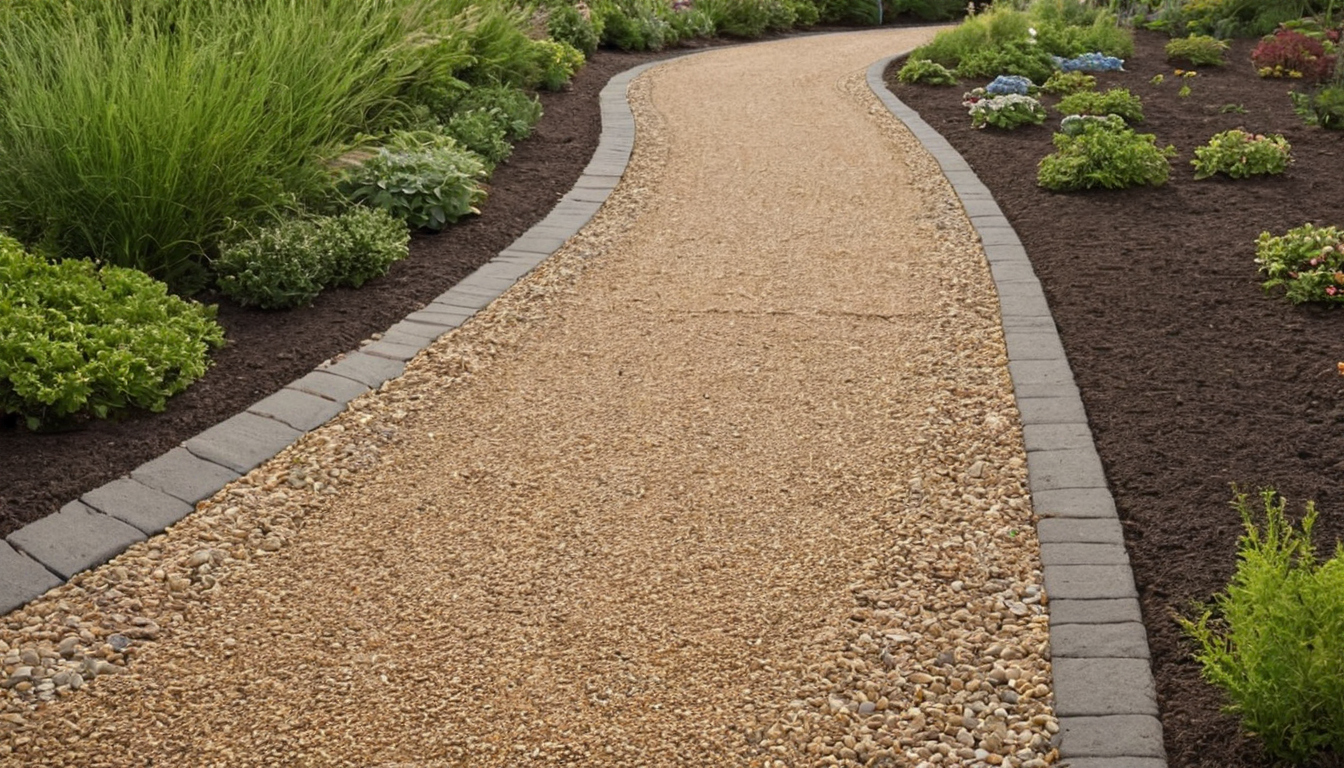
Does a pea gravel path or patio drain without creating runoff problems shown with practical accessibility cues.
Permeable appearance does not prove whole-system permeability
A fast-draining surface can conceal a saturated base over compacted clay. Trace water through surface entry, temporary storage in aggregate voids, subgrade infiltration and an outlet or overflow route.
- Verify the subgrade. Use the soil evaluation or infiltration method accepted by the local stormwater authority.
- Define the base function. Dense-graded aggregate supports loads but provides limited storage. A permeable stormwater assembly needs verified void-space data and locally required design-storm sizing.
- Provide a drainage path. Specify finished fall, an underdrain, a drainage trench or an appropriate combination leading to an approved outlet.
- Plan for overflow. Keep exceedance flows away from doors, planting beds, unstable slopes and sediment-sensitive drains.
Drainage must direct water away from buildings and unstable slopes
Patios beside foundations, basement walls and low thresholds need more than a permeable finish. Confirm locally required fall, threshold clearance and waterproofing before setting excavation depth. Where infiltration beside a structure is restricted or risky, separate the assembly and convey water to an approved outlet.
- Check stormwater setbacks, utility locations and discharge restrictions.
- Do not direct runoff across neighboring property.
- Consider an underdrain where soil is slow, seasonally saturated or confined.
- Protect every outlet against erosion and exposed base aggregate.
With the water route established, the perimeter becomes the next point of failure.
Edging and stabilization keep pea gravel contained under use
Pea gravel needs continuous edge restraint where it meets lawn, soil, paving, steps, drains or grade changes. The edge must resist expected loading without creating a trip point. A stabilization grid improves confinement but cannot replace a prepared base.
Edge restraint selection depends on loading, soil, exposure, and appearance
| Restraint | Best fit | Primary check |
|---|---|---|
| Steel | Thin visible or concealed edges | Corrosion protection and stake capacity |
| Aluminum | Curves and corrosion-prone sites | Strength under mower wheels |
| Concrete | Permanent heavy-duty borders | Footing, joints and freeze-thaw exposure |
| Masonry | Patios and formal paths | Supported base and restrained joints |
| Timber | Informal economical edges | Decay resistance and ground-contact rating |
| Recycled plastic | Flexible landscape borders | Ultraviolet stability and allowable loading |
| Paver edge | Transitions to unit paving | Base continuity and lateral restraint |
Specify section size, embedment, joints, curve radius, durability and manufacturer-required stake spacing. Generic edging can buckle beneath furniture, mower wheels or maintenance carts. Use rigid, flush transitions at doors, intersections, steps and drains. Keep settled gravel slightly below the restraint top without creating a wheel-catching groove.
A stabilization grid must be specified as a tested system
Specify cell dimensions, base preparation, compatible infill, maximum slope, load rating, anchorage, filling procedure, warranty and maintenance limits. Require the test method or authority acceptance supporting an accessibility claim. Covered ground surfaces must be firm, stable and slip resistant according to the U.S. Access Board; exposed cells, displaced gravel and deformation can defeat that performance.
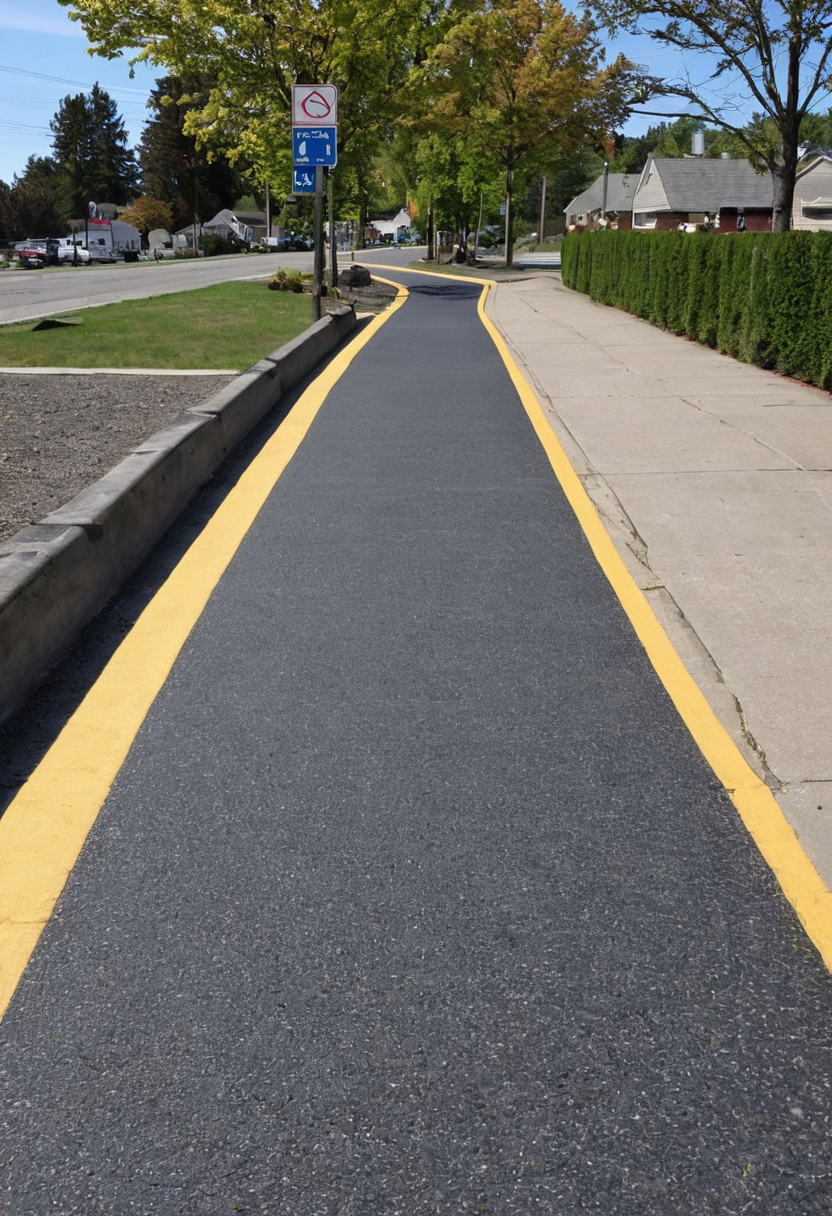
Edging and stabilization keep pea gravel contained under use shown as a mobility planning reference.
Containment solves migration, not accessibility. The complete route must still work for its intended users.
Loose pea gravel is not automatically an accessible route surface
An accessible surface must meet governing requirements for firmness, stability, slip resistance, slope, width, openings, level changes and transitions. Loose pea gravel often shifts beneath wheels and mobility-aid tips. Specify a documented stabilization assembly or choose a compliant bound surface.
Accessibility depends on the complete route, not only the gravel finish
Jurisdiction determines the standard. Covered state and local government facilities and public accommodations fall under different parts of the 2010 ADA Standards. Public-right-of-way and federally managed work may face additional agency requirements. The General Services Administration adopted PROWAG through its Federal Management Regulation on July 3, 2024.
- Check running slope, cross slope, clear width, turns and passing areas.
- Inspect gates, landings, grates and utility covers.
- Control openings, level changes, thresholds and edge transitions.
- Prevent ponding, displaced gravel and routes narrowed by planting.
Minimum dimensional compliance does not guarantee comfortable movement. An uneven route can remain tiring or jarring for wheelchair, walker, cane and stroller users.
Stabilized gravel needs documented firmness and stability performance
An accessibility claim needs test results or authority acceptance for the complete installed assembly, including the specified aggregate, base, cell fill, loading, slope and maintenance conditions. Manufacturer literature cannot override the authority having jurisdiction.
U.S. Access Board guidance notes that the ADA Standards prescribe no minimum coefficient of friction and recommends avoiding bumpy accessible surfaces. Treatments may need maintenance or reapplication. Rutting, loose aggregate, exposed grid and edge lips require prompt correction.
How should pea gravel be selected, measured, and ordered?
Purchase pea gravel by verified gradation, cleanliness, shape, color, source and delivered bulk density, not by product name alone. Suppliers may label different particle ranges as “pea gravel” or “p gravel.”
Pea gravel names do not guarantee a consistent gradation
A search for “pea gravel near me” should start supplier screening, not finish the specification. Request a sieve analysis or declared particle-size range. Confirm source, rounded or subrounded shape, wash status and fines content. Approve a physical sample for color, texture and consistency with adjacent landscape materials.
For stabilized work, compare the sample with the grid manufacturer’s permitted aggregate. Stone that bridges over cells, falls through openings or prevents complete filling is unsuitable.
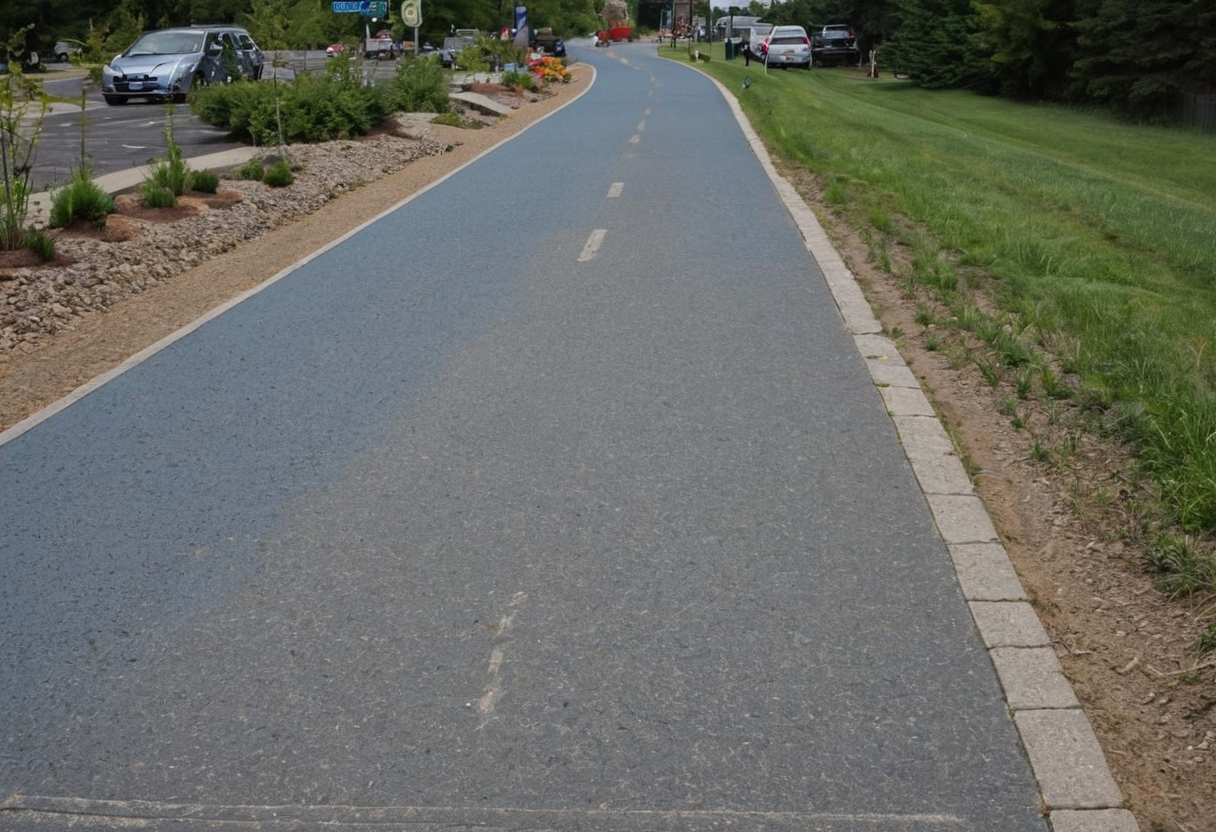
How should pea gravel be selected, measured, and ordered shown as a mobility planning reference.
Order quantities must use finished depth and supplier-specific density
Measure net surface area after deducting planters and paving bands. Calculate volume as area × specified finished depth using consistent units, then convert volume using the supplier’s bulk density or coverage factor. Add a documented allowance for placement and replenishment. Confirm batch consistency, truck access and a protected dump location before release.
A pea gravel installation should follow a hold-point checklist
Reliable installation depends on inspecting every hidden layer before coverage. The contract should identify who approves each hold point and the criteria for elevation, depth, slope, compaction and anchorage.
Hidden work should be inspected before pea gravel is spread
- Preconstruction: Confirm utility marking, permits, drainage approval, access, samples and finished elevations.
- Excavation: Verify depth, positive drainage and protection of foundations, thresholds and utilities.
- Subgrade: Check for pumping, rutting and soft zones. Undercut failures or obtain geotechnical direction.
- Base: Record aggregate, compacted lift thickness, moisture conditioning, elevations and acceptance results.
- Containment: Check edge embedment, joints and anchorage. Keep grids level and fully supported.
- Finish: Place the specified depth without burying thresholds or exposing cells. Test foot traffic, furniture, relevant mobility devices, irrigation and drainage.
Maintenance determines whether the surface remains usable
Increase inspection after heavy traffic, intense rainfall, leaf fall, freeze-thaw cycles and snow clearing. Rake displaced stone, replenish low areas, remove sediment, repair edges and cover exposed grid. Regrade when ruts, ponding, unstable furniture or abrupt transitions appear.
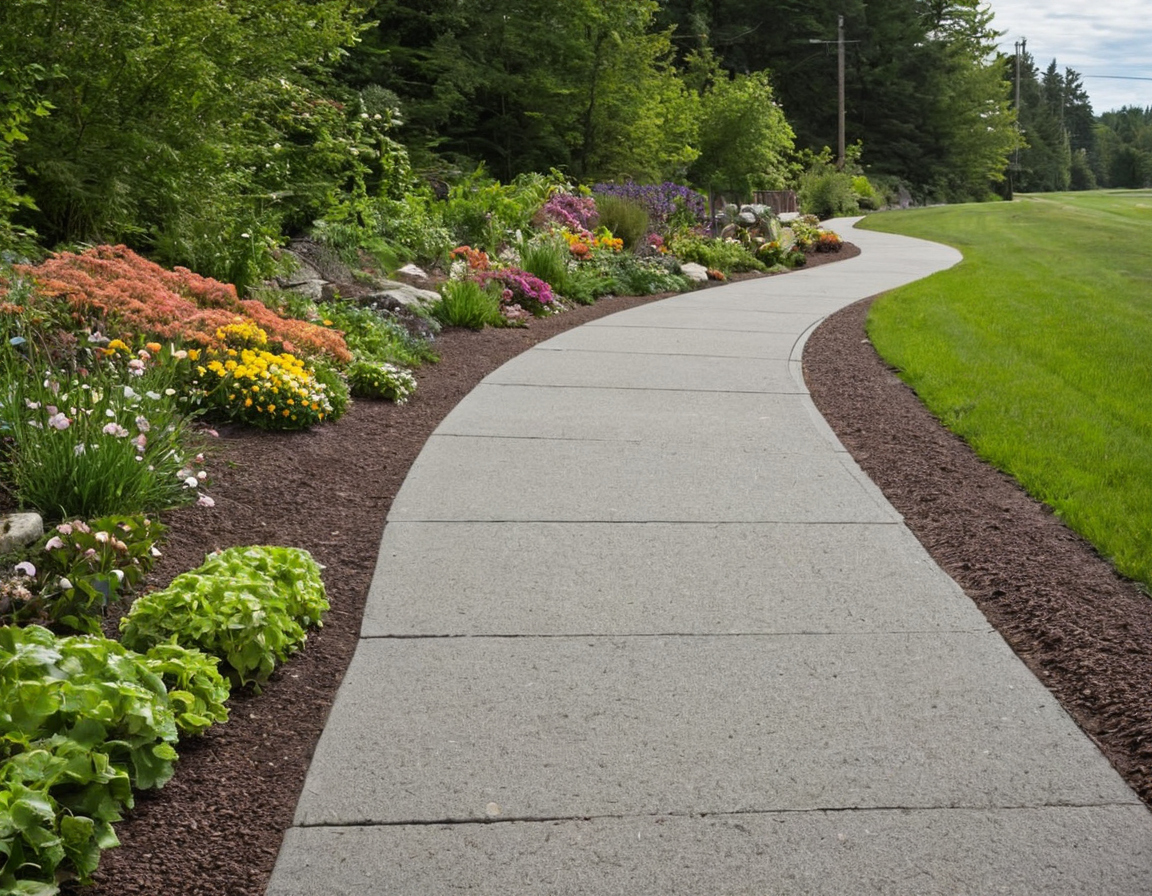
A pea gravel installation should follow a hold-point checklist shown with practical accessibility cues.
The Access Board published final PROWAG guidelines on August 8, 2023, but publication alone does not establish which agency adoption governs a project.
The final question is not “Which gravel looks best?” It is “Which complete assembly can this site, maintenance plan and user group support?”
Frequently asked questions
How deep should pea gravel be for a residential patio after the base is compacted?
A preliminary residential detail commonly uses 1.5 to 2 inches of pea gravel over 4 to 6 inches of compacted base. Soil, frost, drainage and stabilization requirements can change that section.
Is loose or stabilized pea gravel acceptable for a wheelchair-accessible path?
Loose gravel commonly lacks adequate firmness and stability. A stabilized system needs documented performance for the complete assembly and approval under the applicable accessibility requirements.
Does pea gravel provide drainage over compacted soil or dense aggregate?
Surface water may enter the gravel while remaining trapped above slow soil or a dense base. The assembly needs verified infiltration, storage, drainage and overflow paths.
Can pea gravel be used as the patio base?
No. Rounded pea gravel is a finish layer. Use a specified, compacted crushed-aggregate base or an engineered open-graded section beneath it.
What edging best prevents pea gravel from spreading?
The best restraint matches the loading, soil and exposure. Rigid concrete, masonry or properly anchored metal usually provides stronger containment than light flexible edging.