
A hypothetical quote shows the problem: two yards list gravel at $60 per unit, but minimum loads and delivery charges raise the totals to $420 and $610. A search for “landscape supply near me” is therefore a compatibility check, not simply a distance ranking.
How should buyers shortlist a landscape supply yard for a specific project?
A landscape supply yard should be shortlisted against the project’s material, quantity, installation method, delivery location, and site access. Proximity matters only after the supplier confirms suitable stock, workable load sizes, acceptable lead time, and delivery equipment that can reach the unloading point.
What information should a landscape-material request for quote include?
Send every supplier the same request for quote. State the intended use, material name, required size or grading, color or finish, source or product code, acceptable substitutions, quantity and unit, delivery address, requested date, access constraints, and unloading point.
Request product data, photographs or a sample from current stock, applicable installation instructions, and written delivery and return terms. Also confirm whether the material is stocked onsite, transferred from another yard, or ordered from a producer.
A nearby landscape supplier is suitable only when its service matches the installation plan
Match pickup, dump, forklift, crane, curbside, or bagged service to the installation plan. Set a maximum delivered cost rather than a maximum travel distance, then determine whether the documents support the quoted material’s identity and intended use.
Which product documents should a landscape supply yard provide before an order?
A supplier should provide documents connecting the quoted product to its source, product code, current lot or batch, relevant test date, applicable specification, and installation method.
| Material | Identity to confirm | Useful document | Stock link |
|---|---|---|---|
| Aggregate | Size, grading, fines, shape, processing | Sieve analysis or compliance certificate | Quarry and stockpile |
| Soil/compost | Blend, feedstock, analysis | Producer data or laboratory report | Batch and production date |
| Natural stone | Stone type, finish, thickness range | Quarry sheet and range sample | Quarry and pallet |
| Manufactured units | Product code, color, dimensions | Technical sheet and installation guide | Lot or production run |
| Drainage/system products | Capacity, compatibility, intended use | System instructions and component list | Model and batch |
How can buyers verify aggregate size, grading, and cleanliness?
Informal names are not specifications. Establish pea gravel size and assembly requirements before requesting quotes. Where a project specification invokes it, ASTM D448 classifies road and bridge aggregate sizes through standard designations and sieve requirements. ASTM C136/C136M determines particle-size distribution by sieving, while ASTM C117 measures material finer than the 75-micrometre No. 200 sieve by washing. The applicable product specification supplies the acceptance limits.
How can buyers confirm that a sample represents current stock?
Record the sample date, stockpile or pallet, quarry, lot, and moisture condition. Approve a range sample where natural color or texture varies. ASTM C702/C702M covers reducing an already representative aggregate sample to testing size while minimizing variation.
Which materials require approved system components?
Pavers, retaining walls, porcelain, pedestals, and drainage products may require specified base, jointing, adhesive, edging, or drainage components. Obtain current manufacturer instructions before comparing quantities.
Which product documents should a landscape supply yard provide before an order shown as a landscape planning reference.
How should landscape-material quantities and minimum load sizes be compared?
Normalize every quote to the same installed quantity, unit, and delivery basis, including allowances, minimum loads, truck limits, and whole-pallet rules.
When is a volume-to-weight conversion reliable?
- Calculate volume from measured area and specified installed depth, then allow for relevant compaction, settlement, cuts, breakage, and handling.
- Request the supplier’s material-specific density, moisture condition, and conversion method. ASTM C29/C29M-23 distinguishes loose and compacted aggregate bulk density, so a loose value is not an installed density.
- Confirm whether billing uses scale weight, loader-bucket volume, bag count, pallet count, or stated coverage.
Do split loads and partial pallets reduce total cost?
- Compare split-load charges, divider availability, contamination risk, pallet deposits, and pallet-break fees.
- Check whether partial pallets or excess bulk material can be returned.
- Compare the delivered total with separate deliveries or pickup, not unit price alone.
How should buyers inspect landscape materials for consistency and contamination?
Inspect current stock at the yard and again before unloading, using the approved sample, product code, lot information, color range, packaging, and written specification as acceptance references.

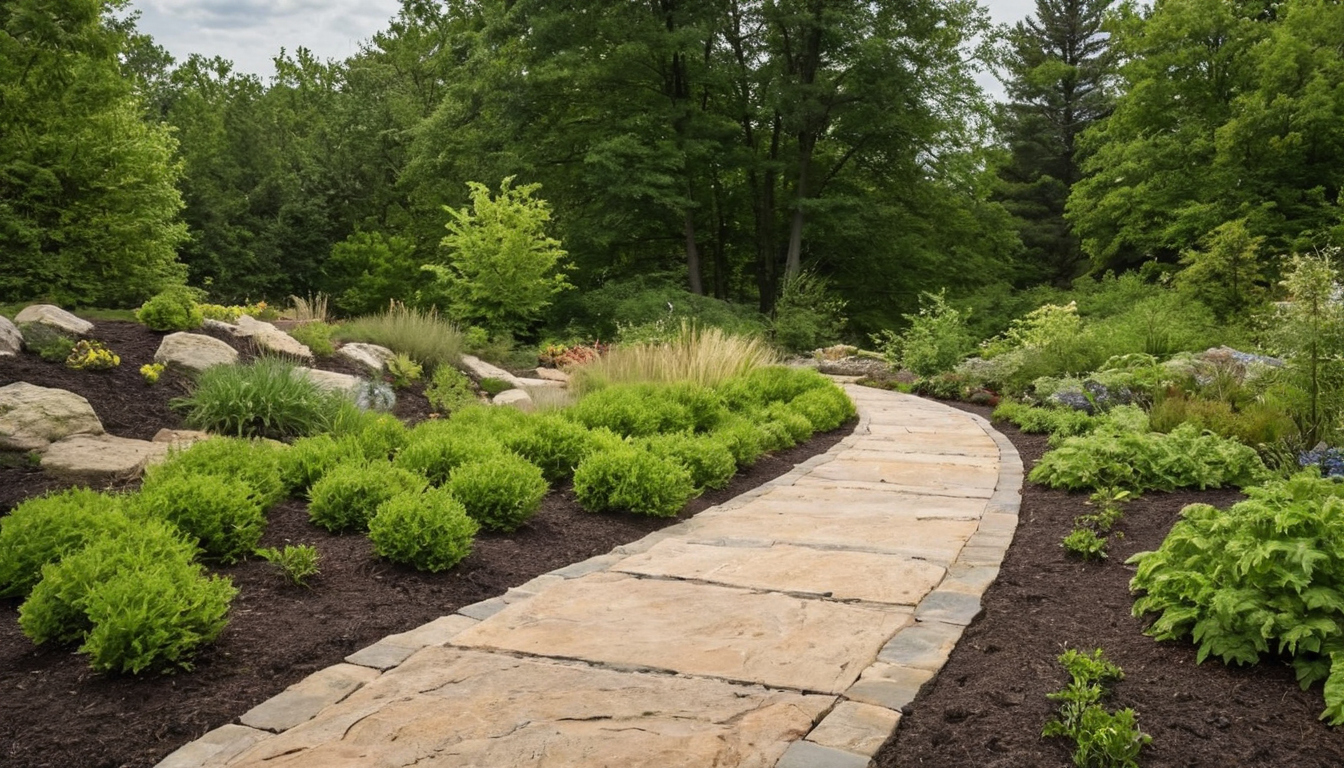
How should buyers inspect landscape materials for consistency and contamination shown with outdoor scale and terrain cues.
What contamination controls should a landscape supply yard use?
- Look for separated and clearly labeled stockpiles.
- Ask how loader buckets, truck beds, conveyors, and bagging equipment are cleaned between products.
- Check aggregate for mixed sizes, excess fines, debris, or staining, and organic materials for rubbish, weeds, foreign aggregate, or inconsistent processing.
- Inspect manufactured units for matching codes, lots, dimensions, finish, and packaging condition.
For concrete aggregate, ASTM C33/C33M-24a establishes grading and quality requirements when the project documents or governing authority invoke that specification. It is not a universal requirement for decorative, drainage, or base aggregate.
When should a delivered load be rejected?
- Stop unloading if the product, source, grading, quantity, color range, packaging, or lot is wrong.
- Reject visible contamination, mixed material, extensive unit damage, or an unsafe unloading condition.
- Photograph the load, labels, ticket, truck, and defect before contacting the supplier.
- Record responsibility for waiting time, return freight, testing, and redelivery.
Can the delivery truck safely reach and unload at the landscape project?
A delivery is feasible only if the selected truck can use the route, fit the site, remain stable, and complete the specified unloading operation.
What changes between dump, forklift, crane, and curbside deliveries?
Dump trucks need stable ground and rear clearance. Forklifts need a firm, sufficiently wide route. Cranes need suitable reach, outrigger support, overhead clearance, and an exclusion area. Curbside delivery requires a defined placement point.
Who is responsible for access, unloading, and property damage?
Written terms should assign access checks, spotters, utility clearance, permits, waiting charges, surface damage, and the driver’s authority to refuse unsafe unloading.
Does street unloading require local approval?
Check municipal or private-road requirements before obstructing a street, sidewalk, or shared route. Confirm approved hours, traffic controls, material storage, drainage protection, and cleanup obligations.

Can the delivery truck safely reach and unload at the landscape project shown with outdoor scale and terrain cues.
Which quote, delivery, and return terms should a landscape supplier confirm in writing?
A complete quote should identify the product, source or brand, quantity, unit price, taxes, deposits, price-validity period, stock reservation, substitutions, delivery method, added charges, waiting time, cancellation deadline, acceptance procedure, and return restrictions.
What does a return policy need to state?
The dated policy should define the return window, required proof of purchase, acceptable condition, packaging and lot requirements, collection or restocking charges, refund method, and exclusions. Bulk material, custom orders, opened packages, plants, mixed lots, and weather-exposed products may have different terms.
How should rejected loads and short deliveries be documented?
Before unloading, photograph the truck, material, labels, scale ticket, defects, and delivery location. Record the notification time, supplier contact, approved sample, lot number, shortage, and requested remedy.

Which quote, delivery, and return terms should a landscape supplier confirm in writing shown as a landscape planning reference.
A landscape supply yard should be selected with a delivered-cost scorecard
The final decision should compare compliant material, usable quantity, delivery feasibility, quality controls, and commercial risk. Mandatory requirements should eliminate unsuitable suppliers before price is considered.
Frequently asked questions
Commercial terms and unloading conditions determine the answers to these common landscape-supply questions.